
How to Cost a Recipe and Work Out Cost Per Portion in a UK Kitchen
To cost a recipe in a UK kitchen, add up the cost of every ingredient at the exact quantity used, divide by the number of portions it yields, and you have your cost per portion. To check whether that price works, divide the cost per portion by the menu selling price (excluding VAT) and multiply by 100 — that's your food cost percentage, which most UK kitchens aim to keep between 30% and 35%.
That's the short answer. Below is the full method, with the real-world details that trip people up: pack sizes, waste, yield loss, and VAT.
Step 1: Break the recipe into ingredients and exact quantities
Write out every single ingredient — including the ones people forget, like oil for frying, seasoning, garnish, and the splash of cream in a sauce. Then convert each to the unit you'll actually buy it in.
For example, a portion of mushroom soup might use:
- 200g chestnut mushrooms
- 50g onion
- 15g butter
- 100ml double cream
- 5g salt, pepper, thyme
- 250ml vegetable stock
Be honest about quantities. Guessing "a knob of butter" is where margins quietly disappear. Weigh things once and write the grams down.
Step 2: Find your true cost per unit
This is the part most people get wrong. You don't cost an ingredient by the pack — you cost it by the gram, millilitre, or each.
Take what you paid and divide by the pack quantity:
- Chestnut mushrooms: £3.20 for 1kg (1000g) = £0.0032 per gram
- Double cream: £1.80 for 1 litre (1000ml) = £0.0018 per ml
- Butter: £1.50 for 250g = £0.006 per gram
Always use the price you actually pay your supplier, not the supermarket shelf price. And use the ex-VAT price. Most raw food ingredients in the UK are zero-rated for VAT, but some aren't — confectionery, snacks, alcohol, and hot takeaway items can carry VAT, so check your invoices rather than assuming.
Step 3: Multiply quantity by unit cost
Now multiply each ingredient's quantity by its cost per unit:
| Ingredient | Quantity | Unit cost | Line cost |
|---|---|---|---|
| Chestnut mushrooms | 200g | £0.0032 | £0.64 |
| Onion | 50g | £0.0011 | £0.06 |
| Butter | 15g | £0.006 | £0.09 |
| Double cream | 100ml | £0.0018 | £0.18 |
| Stock | 250ml | £0.0008 | £0.20 |
| Seasoning | 5g | — | £0.03 |
| Total | £1.20 |
If this recipe makes 4 portions, your cost per portion is £1.20 ÷ 4 = £0.30.
Step 4: Account for waste and yield loss
For the full method — including worked examples for meat, fish and veg — see the guide to working out yield percentage and trim waste.
Raw ingredient cost isn't the whole story. Two things eat into it:
Trim and prep waste. If you buy whole carrots and peel them, you're paying for the peel you throw away. A carrot might lose 15–20% of its weight in prep. So if a recipe needs 800g of peeled carrot, you actually need to buy and pay for around 1kg.
To handle this, add a yield factor. If usable yield is 80%, divide your required weight by 0.8 to get the purchase weight, then cost that.
Cooking loss. Meat especially shrinks. A 200g raw chicken breast might serve as 150g cooked. If your portion is defined by cooked weight, cost the raw weight you actually started with.
Ignoring these two factors is the single biggest reason kitchens think they're making money when they're not.
Step 5: Work out your food cost percentage
Cost per portion only means something next to your selling price. The standard UK calculation is:
Food cost % = (cost per portion ÷ selling price ex-VAT) × 100
If your soup costs £0.30 a portion and you sell it for £5.50:
- The menu price includes 20% VAT, so the ex-VAT price is £5.50 ÷ 1.2 = £4.58
- £0.30 ÷ £4.58 × 100 = 6.5% food cost
That's an excellent margin for a soup. Most operators target an overall food cost of 30–35%, balancing cheap dishes (soups, pasta) against expensive ones (steak, fish) so the average lands where it needs to.
Always strip out VAT before calculating. That £5.50 on the menu isn't all yours — £0.92 belongs to HMRC. Costing against the gross price flatters your margins and leads to underpricing.
Step 6: Work backwards to set a price
Once you know your cost per portion, you can set a price to hit a target food cost:
Selling price (ex-VAT) = cost per portion ÷ target food cost %
For a £2.50 dish at a 30% target:
- £2.50 ÷ 0.30 = £8.33 ex-VAT
- Add 20% VAT: £8.33 × 1.2 = £10.00 menu price
Round to a sensible menu number and you're done.
Step 7: Scale the recipe for batch prep
Costing is per-portion, but kitchens cook in batches. If your costed recipe is for 4 portions and you need 40 for a function, multiply every ingredient by 10. Keep the per-portion cost the same, but the scaled quantities tell your team exactly what to prep and order.
This is also where a prep sheet earns its keep: a printed list of scaled quantities your team can follow during service, with the costings baked in.
Things that quietly wreck your costings
- Stale prices. Ingredient costs move constantly. Re-cost your top dishes every few months, or whenever a key supplier price jumps.
- Forgotten garnishes and oils. Small per-portion costs add up over thousands of covers.
- Mixing up gross and ex-VAT. Pick one — ex-VAT — and stick to it everywhere.
- Ignoring portion drift. If your team plates 220g when you costed 200g, your real food cost is 10% higher than your spreadsheet says.
A quick checklist
- List every ingredient and exact quantity.
- Convert pack prices to cost per gram/ml/each, ex-VAT.
- Multiply quantity × unit cost and total it.
- Adjust for trim and cooking yield.
- Divide by portions for cost per portion.
- Calculate food cost % against the ex-VAT selling price.
- Re-cost regularly.
Doing this by hand or in a spreadsheet works, but it's slow — and the maths gets fiddly once you're juggling pack sizes, yields, VAT and batch scaling across a whole menu.
If you'd rather paste in a recipe and get the cost per portion, food cost % and a printable prep sheet straight away, PrepSheet does exactly that — it's free, runs in your browser with no signup, and your recipes save locally. You can try it here whenever you're ready.
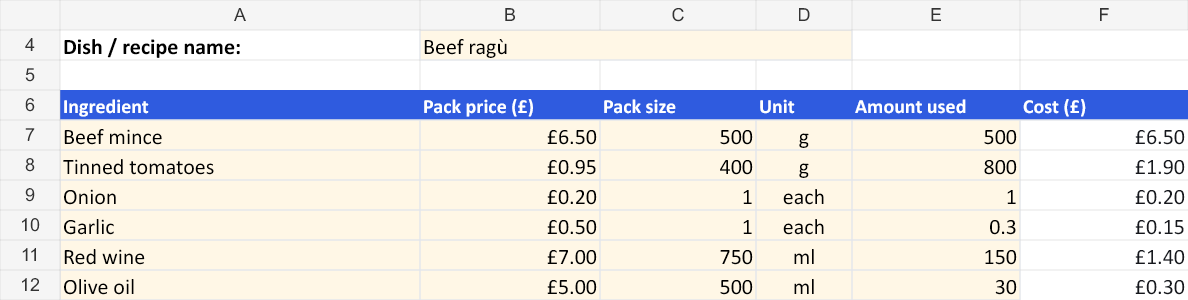
Worked example: the ragù in our worksheet
The sample worksheet below costs beef mince at £6.50, tomatoes at £1.90, onion at £0.20, garlic at £0.15, wine at £1.40 and oil at £0.30. Total batch cost: £10.45. Four equal portions cost £2.6125 each, displayed as £2.61.
At an illustrative 30% food-cost target, £2.6125 ÷ 0.30 = £8.71 before VAT, rounded to the nearest penny. Use the unrounded portion cost in the calculation. This is the ragù only: pasta, cheese, garnish, packaging, labour and overheads are not included. Add those relevant to the dish before choosing a selling price.
Assumptions: the listed quantities are fully used, the batch yields four portions, and ingredient and selling prices use a consistent VAT basis. These are sample prices, not current supplier quotes.
Run the free calculator → · See the templates → · Save your recipes free →